The opinions found on these pages are my own. They are not the opinions of the school or district where I work.
Friday, January 28, 2011
Thursday, January 27, 2011
Secretary of Education Arne Duncan taking questions today about State of the Union speech. Submit your questions here.Or on facebook.
Labels:
Arnie Duncan,
education
Tuesday, January 25, 2011
Algebra webinar from Bootstrap
Bootstrap
Bootstrap [http://www.bootstrapworld.org] is an algebra-focused curriculum, which introduces students to functional programming by having them program their own videogames in a web-based IDE [http://www.wescheme.org]. The curriculum, freely available since 2006, currently reaches hundreds of at-risk middle school students around the country.
During the event, Emmanuel Schanzer (the creator and director of the program) will discuss the research and theory behind Bootstrap's algebra connection, and introduce the curriculum and software package. This talk is aimed especially at math and programming teachers who work with students in grades 6-12.
Login
All Math 2.0 events are free and open to the public. Information about all events in the series is here: http://mathfuture.wikispaces.com/events
Saturday, January 22nd 2011 we will meet in the LearnCentral public Elluminate room at 11am Pacific / 2pm Eastern time.
To join:
* Follow this link: http://tinyurl.com/math20event
* Click "OK" and "Accept" several times as your browser installs the software. When you see Elluminate Session Log-In, enter your name and click the "Login" button
* You will find yourself in a virtual room. An organizer will be there to greet you, starting about half an hour before the event.
If this is your first Elluminate event, consider coming a few minutes earlier to check out the technology. The room opens half an hour before the event.
About Bootstrap
Bootstrap is a curriculum for middle-school students. It teaches them programming through the media of images and animations. It consists of nine 90-minute lessons, delivered once a week in an after-school setting, with accompanying handouts and software. Our primary delivery network is Citizen Schools, who make it easy for community professionals to teach after-school classes as volunteers.
Event Host
Bootstrap is the creation of Emmanuel Schanzer, a former Citizen Schools employee and now a Doctoral Student at the Harvard Graduate School of Education. He began teaching Computer Science in 2000, teaching students at Cornell University how to program in Scheme, and later constructed Bootstrap to teach the same concepts as part of an afterschool program. He is now studying Cognitive Science and Mathematics Instruction.
Algebra webinar from Bootstrap
Wednesday, January 19, 2011
Monday, January 17, 2011
It Takes a Village School
It takes a village to raise a child was a book based on an African proverb.
The school is one of the parts of the village that is community owned. When the conventional wisdom of the village decides that all children should receive the same services often the school is asked to provide. Students need immunizations, let it be a requirement for school. Children need to eat healthier, let the school serve lunch, and breakfast. Students aren’t entering school ready to read, start school younger. Field trips to farms, museums, and even bowling alleys all become common background experiences for students to share. Some may feel that schools are asked to do too much and some think they should do more, but that is a question of detail. Like it or not schools, even home-schools and virtual schools, are an integral part of what it means to grow up in America, and most of the world.
I don’t think it is wrong to tie the common needs of students to school. I think it is wrong when we expect everything to be done by the school when we still think of school just a place to learn stuff.
Schools are the place where learning occurs. Specifically schools teach the basic building blocks for higher-level learning and discussion that will be expected of students later in life. For many this means learning to read, write, some history, and arithmetic.
In a village school students learn these basic when they learn the one most important skill the ability to think. Students in a village school don’t learn to read because there are letters and words to memorize, reading is learned because that is the best way to share experiences and convey information. History, Math, Science all become tools to use to explore and share the world and bring value back to the village.
In the end schools have two related purposes: to nourish the desire to learn and give students the tools to continue learning on their own.
Related articles
- Philosophy of Education (jhuistemurphy.wordpress.com)
- Lion's Pride program puts Linn-Mar teachers in the community (thegazette.com)
- Caves with a legacy of five generations (thehimalayantimes.com)
- "Rhee's Plan: Students (Test Scores) First!" and related posts (blogs.edweek.org)
- After-school advantage for children in Tamil Nadu villages (klp.org.in)
It Takes a Village School
Tuesday, January 11, 2011
The Poster Session
I'm already planning for my big summer presentation. How it is possible to use web 2.0 technologies, specifically a wiki, to help teachers and administrators across schools to collaborate on math curriculum.
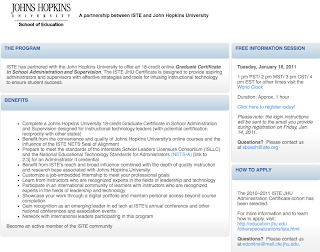
As some of you may know I am currently taking a graduate certificate course through Johns Hopkins University and the International Society for Technology in Education.
One of the requirements for this program is to present at the annual ISTE conference (Formally the NECC conference). 18,000 people are expected to attend this conference.
I hope to present the best of Waukegan Public Schools. I will appreciate any and all help given. Actually, the entire project is about how administration and teachers can work together to get this done.

As some of you may know I am currently taking a graduate certificate course through Johns Hopkins University and the International Society for Technology in Education.
One of the requirements for this program is to present at the annual ISTE conference (Formally the NECC conference). 18,000 people are expected to attend this conference.
I hope to present the best of Waukegan Public Schools. I will appreciate any and all help given. Actually, the entire project is about how administration and teachers can work together to get this done.
The Poster Session
Labels:
brendan muprhy,
education,
resources
Subscribe to:
Posts (Atom)